What Would It Really Take to Replace the Trees on Your Property?
By Forest, Property Intelligence Specialist, Ken's Tree Service. Last reviewed November 11, 2026. Next review due May 11, 2027.
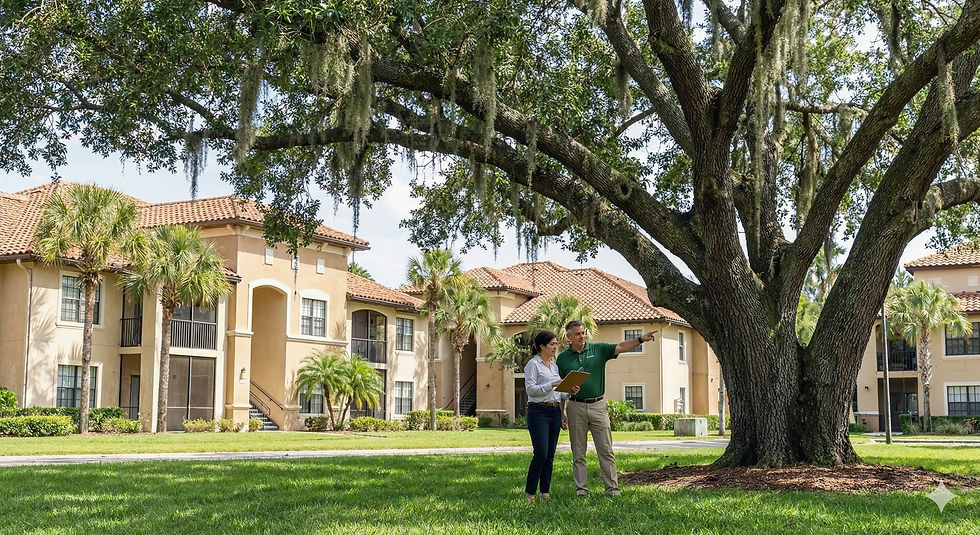
Think about the biggest live oak on your property, the one everybody tries to park under in August. If a storm took it down next week, what would it take to put that same tree back?
For a tree that size, the honest answer is that nobody really can. You can't buy one, and moving a mature tree in from somewhere else is a heavy-equipment project of its own, when it can be done at all. What you can do is estimate what it would cost to replace, using a method built on the one tree appraisers in North America use. That estimate is part of Tree Asset Intelligence, the record we keep for every tree we look after on a property. It lets the people who set the tree budget see what their trees are worth before something happens to one, and it can change the whole budget conversation.
Why isn't planting a new tree the same as replacing one?
When a big tree comes out, the usual answer is to plant a nursery tree, or a few of them, and call it replaced. On paper the trees are back. In the shade over the parking lot, they aren't.
Trunk size makes the gap easy to see. The area of a slice straight across a trunk grows with the square of its diameter, so a trunk twice as wide has four times the area. To match the trunk of one 30-inch oak, you'd need 225 trees with 2-inch trunks. Nobody plants 225 trees to replace one, and even if they did, it would take many years before any of them did what the old tree did.
So when we talk about replacement value, we mean replacing a tree like for like: the same species, at the same trunk size. That's the only kind of replacement that actually puts back what was lost.
How do you put a number on a tree you can't buy?
Tree appraisers have worked out an answer, and it's the starting point for ours. The Guide for Plant Appraisal, the reference appraisers in North America work from, published by the International Society of Arboriculture, calls it the trunk formula technique. A 2025 journal comparison of appraisal methods describes it as built "to estimate the replacement cost of an individual tree too large to be replaced" (Arboriculture and Urban Forestry, 2025). It starts from the largest nursery tree that's commonly available and scales its cost up by trunk size.
Here's how we work it:
Find what it costs to buy the largest commonly available nursery tree of the same species, and to get it planted and growing. Species that sell at close to the same price share one cost.
Divide that cost by the nursery tree's trunk area. That gives a cost per square inch of trunk.
Multiply by the trunk area of your tree.
Trunk area means the area of that slice straight across the trunk, worked out from the diameter. We measure each trunk with a diameter tape at four and a half feet above the ground, and the latest tape reading is the one we use.
Step 1 is where we make a choice of our own. The Guide's worksheet divides the price of the nursery tree alone by its trunk area, and then lists the cost of installing it as a separate line. We build planting and early care into the cost per square inch, because a tree bought at wholesale doesn't plant itself. So for a big tree, our figure comes out higher than a strict worksheet would give.
Because area grows with the square of the diameter, value climbs fast as a tree gets bigger. A 24-inch oak has 16 times the trunk of a 6-inch one. One 40-inch oak has more trunk than nine 12-inch oaks put together. That's why a few big trees can carry so much of a property's total.
We built on an established method rather than inventing one, so a board can see where each step comes from.
What goes into the installed cost?
The cost that counts is the one a property would actually pay: the tree, getting it there and into the ground, and the watering and care until it takes hold. The Guide's own worksheet lists replacement tree installation and aftercare among the costs of replacing a tree.
Size is where it gets real. The size chart in Florida's grading standard for nursery trees like live oak, magnolia and red maple runs up to a 10-inch trunk, and at that size it calls for a dug root ball at least 80 inches across, or a container of at least 670 gallons (Florida Grades and Standards for Nursery Plants 2022, page 17). In our experience, up to about 10 inches of trunk a tree spade can dig a tree and move it. Past that, moving a tree takes a crane and a project of its own, so for a very large tree the real cost of putting it back would run higher than our estimate.
What does the estimate leave out on purpose?
We leave three things out, and each one keeps the number honest.
Condition. The Guide goes on to adjust a value for a tree's condition and its site. We stop before that step. Our figure estimates what it would cost to put back a healthy tree of the same species and size. Trees with less than about five years of life left, or already dead, go on their own line with the value at stake beside them, and they're kept out of the property total.
Invasive species. Nobody plants a camphor tree or a Brazilian pepper to replace one. Both are Category 1 invasives on the Florida Invasive Species Council list (UF/IFAS on camphor; UF/IFAS on Brazilian peppertree). Trees in Category 1 are counted, but they aren't given a replacement value. Trees in the list's second category are valued and flagged.
Palms by trunk diameter. Once a palm is past its young stage, its trunk all but stops getting wider (UF/IFAS, Palm Morphology and Anatomy). So diameter tells you very little about a palm. We value palms by species and height instead.
It's an estimate for planning. An appraisal for an insurance claim or a dispute is a different job, done for a specific purpose.
What does a board do with the number?
The best place for it is next to the tree budget. If your board has never seen a figure for what its trees are worth, the yearly care budget gets judged against last year's invoices. Once the estimated replacement value of the trees on record sits beside the annual care budget, the budget reads as what it really is: the yearly cost of looking after a large asset.
The number also moves. When a tree is measured again, its value is worked out again from the new reading, and our prices are updated once a year. When a tree's condition drops into its last few years, its value moves to the end-of-life line, with the date. Over time a board can see how much value is moving off the total, and when.
For properties on an annual tree program with us, each tree's estimate is recorded once its species and trunk size are measured, beside its condition and history, so it can be shown to a manager or a board.
Sources and scope
Council of Tree and Landscape Appraisers, Guide for Plant Appraisal, 10th edition, Reproduction Method, Trunk Formula Technique worksheet (current as of October 2020), International Society of Arboriculture, read November 11, 2026.
Arboriculture and Urban Forestry, "Right Appraisal for the Right Purpose: Comparing Techniques for Appraising Heritage Trees in Australia and Canada," 2025, read November 11, 2026.
Florida Department of Agriculture and Consumer Services, Florida Grades and Standards for Nursery Plants 2022, Type 1 tree matrix, read November 11, 2026.
UF/IFAS Center for Aquatic and Invasive Plants, plant directory entries for camphor tree and Brazilian peppertree, read November 11, 2026.
UF/IFAS Extension, Palm Morphology and Anatomy (ENH1212), read November 11, 2026.
This article explains how Ken's Tree Service estimates the replacement value of the trees on a property. It's general information, not an appraisal and not an assessment of any specific tree or property.
Want to see how this would work on your property?
Ask the chat assistant on our website. It can walk you through how replacement value works and what an annual program would include for a property like yours. Look for the chat at the bottom right of any page.
Ken's Tree Service has worked in this area since 1996. We cover about 20 miles around our yard in Tarpon Springs, across north Pinellas, west Pasco and the northwest corner of Hillsborough County. You can also call us at 727-934-5804.