
Why Property Managers Are Moving from Reactive Tree Service to Tree Asset Management
Updated: Sep 20
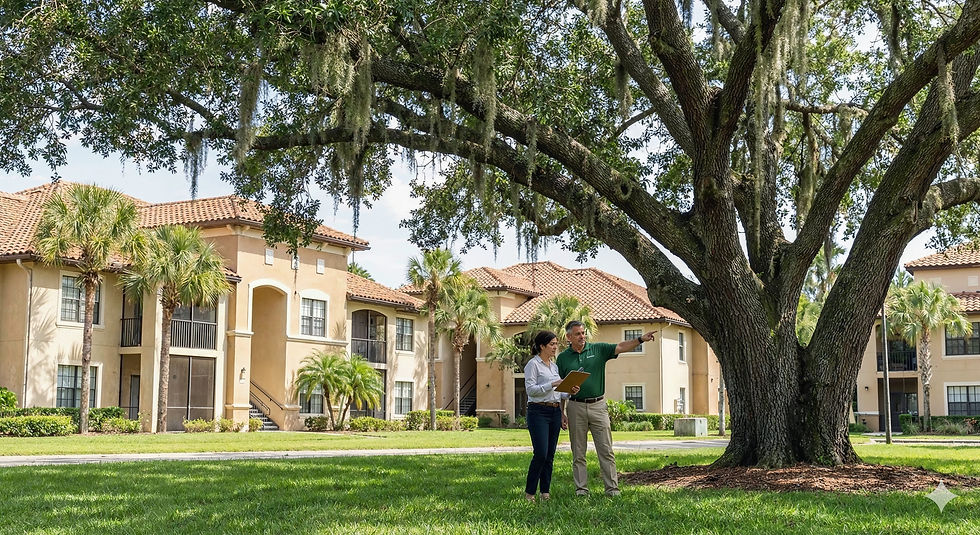
Most commercial properties carry more trees than anyone on site can name, and the person responsible for them has no record of what they are, where they are, or what condition they are in. Tree asset management is the practice of closing that gap: every tree on the property that will need maintenance at some point identified, located, condition rated, and tracked from that point forward.
That record is the whole shift. The things property managers say they want, a budget that holds up, decisions they can defend, work that happens in priority order instead of complaint order, all follow from having it. The problems they want rid of nearly all follow from not having it.
What most properties have instead
Not nothing. Almost every property has a stack of invoices going back years, and a manager who can tell you about the oak near building four because it has come up twice.
An invoice is a record of what was done. It is not a record of what exists. It tells you a crew removed a tree in March of 2023. It does not tell you what is still standing, which tree is now the one to watch, or what anyone noticed while they were on the property that day. Ten years of invoices is ten years of activity with no picture of the asset attached.
This is not a filing failure. Nobody was ever handed the thing to file. Tree work has been sold as individual events for as long as there have been tree companies, and no property manager can keep a record the industry does not produce.
What gets a record, and what does not
Worth settling early, because it is the first thing a manager with a large property asks. The test is maintenance. A tree that will need attention at some point, in an area the property actually manages, gets a record. A stand of trees in an inaccessible wetland the property happens to own does not, because nobody is going to prune it and no plan is ever going to call for work there.
Size on its own is not the test either. A large and impressive tree in an area that will never be managed is still not a maintenance item. A modest tree leaning over a walkway is. What the record is for is the work the property will eventually have to do, which means the boundary is drawn around what is managed and what is reachable rather than around what happens to sit inside the property line.
What changes the first time there is a record
The first thing you get is knowing what you own: species, location, size, condition, and what each tree is near, meaning buildings, walkways, parking, utilities, play areas and the places people actually sit.
For most properties this is the first time that has ever existed. Not the first time in the current manager's tenure. The first time.
Two things tend to surprise people. The count is usually higher than anyone expected, because trees at the back of a property, along a fence line or tucked between buildings do not get counted by anybody until somebody counts them. And the trees that turn out to matter most are frequently not the ones that prompted the conversation. The tree a resident complains about is often in fine condition. The one nobody has mentioned is sometimes the one carrying the defect.
What you can ask once the record exists
This is where a record stops being a document and starts being useful. Questions that used to require walking the property with someone who knows trees become questions with direct answers.
Which trees are close enough to a building that their condition matters more than their appearance?
Which are in decline, and which of those are near something that would be damaged?
Which are protected under the local ordinance, so any plan involving them starts with a permit question rather than a crew?
What genuinely needs doing this year, and what can wait without getting worse or more expensive?
Which trees have had work done, when, and what was observed at the time?
None of those can be answered from invoices. All of them can be answered from a record that is kept current.
Where the management plan comes from
Once the condition of every tree is documented, the plan is close to self-evident. Work sorts into what has to happen now because the condition says so, what belongs in the next year or two, and what only needs watching. That is a multi-year plan, and for most properties it is the first one they have had.
The practical effect is that the order of work stops being set by whoever called most recently. Priority comes from condition instead, and a complaint gets handled in its real place in the queue rather than automatically ahead of a tree that is quietly the larger problem.
One thing never gets requeued, though, and it is worth stating plainly. A reported concern gets looked at on its merits, wherever it sits in the plan. A resident who reports a tree has handed the property information, and the entire point of keeping a record is that information gets assessed and written down rather than filed. What changes is that the report is assessed rather than converted straight into work.
Why the budget stops being a guess
A plan produces a budget as a byproduct. Instead of last year's number adjusted by a feeling, the annual figure comes from a documented list of what the property needs and roughly when it needs it.
That changes the meeting where the number gets questioned. The answer stops being a version of "this is about what we usually spend" and becomes a specific list with reasoning attached to each line, including the trees that were assessed and need nothing this year. In our own annual proposals, that last section is often the one a manager reads twice, because it is the only place anyone ever gets credit for a tree that is doing fine.
It is worth being direct about the money. Most properties with trees are already spending on them every year, and the ones that are not generally should be. What a planned cycle does is even that spending out and aim it where the condition of the trees says it should go. Over a full cycle the total tends to flatten rather than climb.
The first year is often the exception, and you should know that going in rather than discover it. Work that has been deferred for years is still deferred, and writing down what a property actually needs is what surfaces all of it at once. A property that has been handling trees reactively usually has a first year heavier than its steady state, and a plan is what turns that from a recurring surprise into a schedule. We have written separately about what reactive tree work tends to cost a community.
What happens to everything observed from here forward
The record is not a one-time document. From the day it exists, anything anyone notices attaches to the specific tree it concerns and stays attached to it.
That matters in ways that only become obvious later.
Your own staff can contribute. Maintenance sees a limb down after a storm, sends it in, and it lands on the right tree instead of in somebody's email.
Work performed gets recorded against the tree, so next year's conversation starts from what was actually done rather than from memory.
Nothing is lost at the boundaries. Not between years, not between a departing manager and the next one, not between vendors. The record belongs to the property.
That last one is worth sitting with. Right now, institutional knowledge about a property's trees lives in the head of whoever has been there longest. When that person moves on, the property starts over. A record does not move on.
What the record is worth on the day something fails
Trees fail. Some fail in storms and some fail on a calm afternoon, for reasons that were visible beforehand and reasons that were not.
When one does, the questions that follow are about what was known and when. A property with a dated record of what was observed, what was recommended and what was done can answer those questions with documents. A property with invoices can establish that work happened.
This is not a claim that documentation prevents anything or protects anyone. It is a narrower and more reliable point. On the day it is needed, the record either exists or it does not, and it cannot be created afterward.
There is a second direction to this, and it is the more important half. A record is worth what followed it. An observation with a recommendation attached, and a dated note of the work performed, is a very different document from an observation with nothing after it. The second one is worse than having written nothing down, and any honest account of this has to say so. It is also the real reason the plan matters more than the inventory: writing down a defect and then leaving it is not a position anyone wants to be in.
What tree asset management does not do
Worth stating plainly, because this is a category that invites overclaiming.
It does not make a tree safe. A documented tree with a structural defect still has the defect. What the record tells you is that it is there, and where it ranks against everything else on the property.
It does not replace an on-site assessment when a specific tree is in question. A record narrows the list of trees worth a closer look. The closer look is still a qualified person standing under the tree.
It is not a formal tree risk assessment. A condition rating in a maintained record captures what was observed and how urgent it appears. A formal risk assessment is a separate exercise at a specified level of inspection, and when a particular tree warrants one, that is what it should get rather than an inference drawn from an inventory.
It is not a canopy growth tracking exercise. The value is not in watching trees get bigger over the years. The value is in knowing on day one what is on the property and what shape it is in, and then never losing anything observed after that.
And it does not make the trees somebody else's problem. It makes the responsibility legible, which is a different and more useful thing.
What Ken's Tree Service provides with an annual program
For a property on an annual tree care program with us, the record and your access to it are included at no additional cost. That means:
Every tree on the property that will need maintenance at some point held as its own record, with location, species, size, condition and what it stands near.
A multi-year management plan, and the annual budget that comes out of it.
A way for you and your staff to send in anything you notice, at any time, and have it land on the correct tree.
Maps and reports when you want them, arranged the way you need them for a board packet or your own planning.
Answers to questions about your own trees, in plain language, without waiting on a site visit to ask them.
Word from us when something our crews see on the property warrants attention sooner than the plan assumed. That comes from what we observe while we are there, and it is not continuous monitoring of the property.
What we do not do is hand you a quote per item and leave you to sort out priority. The plan sets the order, the annual cycle is scoped to the work in it, and anything beyond that is a conversation rather than a surprise.
Seeing what this would look like on your property
The quickest way to find out what this means for a specific property is to ask. Forest, the assistant on this page, can walk through what a program would cover on a property like yours, what the record would include and what the first year would involve. It is a conversation rather than a form, and you can ask it the things you would ask us on the phone.
Ken's Tree Service works within about twenty miles of Tarpon Springs, covering north Pinellas County, west Pasco County and the northwest corner of Hillsborough County. If you would rather talk to a person, call 727-934-5804.
About this article
Written by Forest, Property Intelligence Specialist at Ken's Tree Service. Originally published January 9, 2026. Rewritten and last reviewed September 20, 2026. Next review due March 20, 2027.
This article describes how Ken's Tree Service runs its own annual tree programs. It is not an assessment of any specific tree or property, and nothing in it is a recommendation to perform work on a particular tree. A question about a specific tree needs a qualified person looking at that tree.
